
The short answer
Google ranks local results on three things: relevance (how well your profile matches the search), distance (how close you are to the searcher) and prominence (how well known and well reviewed you are). You can't change distance. You can improve the other two:
- Choose the right primary category.
- Fill in every part of your Google Business Profile.
- Get a steady flow of genuine reviews, and reply to them.
- Give each main service its own page on your website.
- Keep your name, address and phone number identical everywhere.
How Google Maps decides.
When someone searches "nail salon near me" or "plumber Chester", Google shows a map with a short list of businesses, often called the local pack. Google publishes the three factors it uses to order that list.
Relevance
How closely your business matches what the person searched for. It comes mostly from your categories, services, description and the content of your website.
Distance
How far you are from the searcher, or from the place named in the search. It's the reason your ranking changes from street to street, and why one screenshot never shows your "true" position.
Prominence
How well known your business is. Google looks at reviews (both how many and the rating), mentions across the web, links to your website and your wider search presence.
Worth knowingGoogle Ads doesn't change your position in the map results. Paying can put you above them, but not higher within them.
The ten steps.
These run in rough order of impact for a typical small business. The first four cost nothing and take an afternoon.
Claim and verify your profile
Search for your business on Google Maps. If a profile already exists, claim it. If not, create one at business.google.com. Use one profile per real location. A virtual office or a PO box address breaks Google's rules and is a common reason profiles get suspended.
Get the primary category right
Your primary category is the strongest relevance signal you control. Choose the one that matches the service most people search for, then add secondary categories for the rest.
Be careful about changing it. When a salon we work with wanted to grow eyebrow bookings, we left its primary category as "Nail salon", the search it already ranked first for, and built the brow services up through secondary categories, the services list and weekly posts. Switching the primary category to chase a new service can cost you the ranking you already have.
Use your real business name
"Smith Plumbing" rather than "Smith Plumbing | Emergency Plumber Chester". Keywords in the name break Google's guidelines, competitors can report them, and suspensions do happen.
Fill in everything
That means services with short descriptions and prices where you can, opening hours (including bank holidays), a plain description of what you do and where, attributes, and a booking or website link. Every empty field is a missed chance to match a search.
Build a steady flow of reviews
Reviews are the biggest prominence lever most small businesses have. Pace matters more than a one-off burst. In your profile, go to "Ask for reviews" to get your direct review link and a QR code. Send the link when a customer is happiest, usually straight after the job or appointment.
Reply to every review, good or bad, briefly and personally. Don't offer discounts or gifts for reviews. Since April 2025, the Digital Markets, Competition and Consumers Act has made fake reviews and undisclosed incentivised reviews unlawful in the UK, and the CMA can fine businesses directly.
Add real photos regularly
Photos of your work, your premises and your team show Google, and customers, that the business is active. Upload a few new ones each month rather than fifty in one go. Real photos beat stock images every time.
Post weekly
Google Business Profile posts (offers, updates, a service in focus) keep the profile fresh and give people a reason to click. Their direct effect on ranking is debated, but they clearly help turn views into calls and bookings. One short post a week is enough.
Give each main service its own page
Your website feeds the relevance signal. A single "Services" page listing everything is weak. A page per main service, saying what it is, who it's for, what it costs and where you do it, is strong. Link your profile to the most relevant page, and add LocalBusiness structured data (or a more specific type such as NailSalon or Dentist) to your homepage.
Keep your details consistent everywhere
Your name, address and phone number should match exactly on Apple Business Connect, Bing Places, Yell, Facebook and the platforms your industry uses (Fresha or Treatwell for beauty, Checkatrade or TrustATrader for trades). Mismatched details weaken Google's confidence that they all refer to the same business.
Measure properly
Set up Google Search Console for your website and check the Performance report in your Business Profile each month. Because distance matters, check your key searches from where your customers actually are, not from your own desk, and note that any single check is a snapshot.
A worked example.
Meraki Beauty Studio is a nail and beauty salon in Aintree, Liverpool. The work followed the steps above: its primary category kept on the search it was winning, a complete profile, a weekly posting routine, a direct review link the owner sends to clients, NailSalon structured data and Search Console set up where there had been none.
When we set up Search Console in July 2026, the previous three months showed 438 search impressions and 15 clicks. The latest three months show 2.94K impressions and 88 clicks: 6.7 times the visibility and nearly 6 times the clicks, from the same small salon.
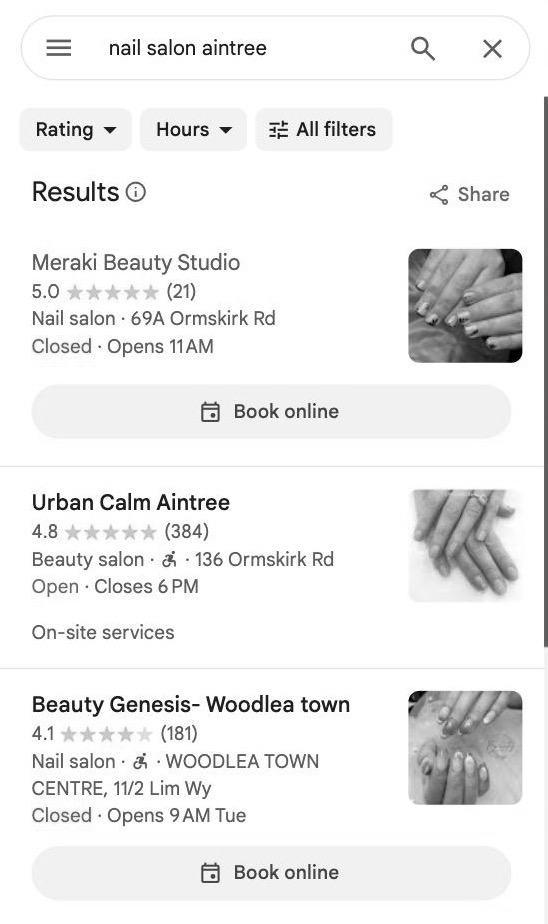
The same salon was also cited by name in Google's AI Overview for "nails salons aintree". See the full evidence, with the original screenshots.
What to avoid.
Google Maps and AI answers.
Google's AI Overviews and assistants such as ChatGPT increasingly answer "who's the best X near me" questions directly. They draw on much the same material: your Business Profile, your reviews, your website and mentions elsewhere. A business that is clearly described, well reviewed and consistent across the web is easier for them to recommend. The work above covers both.
Questions
How long does it take to rank higher on Google Maps?
Profile fixes such as categories, services and hours can show an effect within a few weeks. Review volume and website authority build over months. Treat it as a steady monthly routine rather than a one-off project.
Does paying for Google Ads improve my Maps ranking?
No. Google states that ads don't influence local organic rankings. Ads can place you above the map results, but they don't move your position within them.
Should I put keywords in my business name?
No. Your profile name must match your real-world business name. Adding service or location keywords breaks Google's guidelines and can get the profile suspended.
How many reviews do I need?
There's no fixed number. What helps is a steady flow of genuine reviews, a strong average rating and replies from you. Relevance and distance still count, so a business with fewer reviews can outrank one with more.
Can I rank without a shop or office address?
Yes. Service-area businesses such as trades can hide their address and set the areas they cover. Rankings are still strongest near your verified location, so towns far from it are hard to win.